
DISCLAIMER: If you’re an experienced winter hiker, this hike report is probably not for you. You’ll end up saying “duh” a lot and I’ll just be showing my ignorance. But… if you’re like me, if you grew up in the South, are an ultralight hiker who prefers to go light and fast, and would consider yourself a "beginner" winter hiker even though you have good experience in other seasons, I hope these takeaways and lessons learned can benefit you. So here goes…
—
I’ve spent the past dozen years section hiking the Appalachian Trail and have covered more than 1800 miles on it. I’ve also thru-hiked the Colorado Trail, numerous trails in Europe, and generally covered thousands of miles in national parks and mountains across the US. So it’s safe to say I have a good bit of trail experience.
But in all of those miles of hiking, I had never done an extended winter trip. The extent of my cold weather “expeditions” had been running on the Mountains to Sea Trail after a good snowfall, tromping through the woods with the kids in our neighborhood on a snow day, and one robust climb up Mount Moosilauke in the White Mountains with some experienced New Hampshire friends on a cold December day years ago when the windchill was in the negative teens. Yikes.
I had also not done much extreme cold weather camping other than a night in the southern half of the Smokies one November several years ago on a 35 mile stretch from Fontana Dam to Kuwohi (formerly Clingman’s Dome).
So this was an adventure I was looking forward to. I knew there would be a learning curve. I just didn’t think it would be quite so steep.
Here are my observations and takeaways from the experience…
- Don’t rely on forecasts. Check with locals, park offices and rangers, and also remember that the mountains are almost always going to have more snow than nearby towns and cities at lower elevations. The snow is also going to linger and melt off a lot slower in the mountains. That's especially true of north slopes. Dirt and mud (read, the AT) are going to hold snow and ice more than leaves and other debris in the forest. I could often tell where the trail went up a hillside because it was the only part of the ridge covered in white. Also, a lot of the snow will accumulate at an angle so you’ll have to walk sideways or hug the narrow down slope part of trail without snow.
- Consider waterproof shoes. I’m not a fan of waterproof shoes in general, but I would definitely consider them on a future winter trip. I probably would probably go with waterproof low tops and gaiters over traditional high tops or “boots" but if I found the right pair, I might opt for them. I’d also highly recommend bringing Gold Bond medicated powder. When your feet are wet all day- no matter what the season- it comes in very handy at night for drying out your feet, socks and shoes.
- Bring microspikes! Even if you’re not sure you’ll need them. My rule of thumb is "if in doubt, throw it in the car and decide later." Foolishly, I didn’t do that and was lucky that Warren loaned me a used pair of yak trax. They came in extremely handy on the first night as I climbed to the Priest and most of the next day when I was slogging through cold, nasty conditions.
- I would have used shelters more. I had an opportunity to stop around 3 o’clock at a shelter and should have taken advantage of it. At the time I’d already walked through four hours of freezing rain, snow and ice. The forecast didn't look terrible but it also didn't look good. I think if I had it to do over, I would have stopped at the shelter and hunkered down for the afternoon and evening. I would’ve been bored because I did not bring a book (that’s something else I'd bring in winter hiking, even when hiking ultralight, because it gets dark earlier and isn’t as desirable to hike late), but I would much rather be bored than cold and risk hypothermia.
- I would NOT bring a single walled tent again. My ultralight Tarp Tent kept the rain out, but had WAY too much condensation on the ceiling, which dripped almost constantly onto my down sleeping bag. When down gets wet and loses its loft, it can’t keep you warm. I rolled over on purpose throughout the night to try to keep that from happening and was fortunate it didn’t, but not having a double walled tent (even a heavier one) kept me restless and worried most of the night.
- This is embarrassing to say but in all that cold rain, I didn’t eat and drink enough. I was not enjoying it and just wanted to keep moving. I know better than to go long stretches without eating and drinking. And I felt bad because of it that night, with a mild headache and low energy. As much as the weather turning for the better made a hug difference, so did simply waking up the third day and getting 700-800 calories in me in from the protein bars, trail mix, dried fruit, and peanut butter pretzels I had plenty of. Plying yourself with fuel will will give you the energy to keep going and will also keep your body warmer. When you’re cold and wet, you also don’t think you’re sweating or are at risk of dehydration but you absolutely are, perhaps even more tha when you’re hiking in 100 degree heat because it’s not as obvious.
- I would have brought a better rain jacket. I have already purchased a new on since the one I carried was over a decade old and on its last legs. In some respects, I don't think it would’ve mattered much because when you are in rain for 8 to 10 hours straight, water is going to get in regardless. But my ultralight rain jacket is thinner and I don’t think it holds the heat in as well as a slightly heavier one would. I’d rather carry an extra 6 ounces than be 6 degrees colder. I was fortunate that the weather took a turn for the better on the third day. It warmed up into the lower 50s and the sun even came out, which felt like a miracle after so much dreariness. Another popular thru-hiker option is a good, trail specific poncho. I don't think it would have held in my body heat as much but I do think it would have kept the water out longer and you can always double up with a rain jacket/shell underneath to hold in body heat.
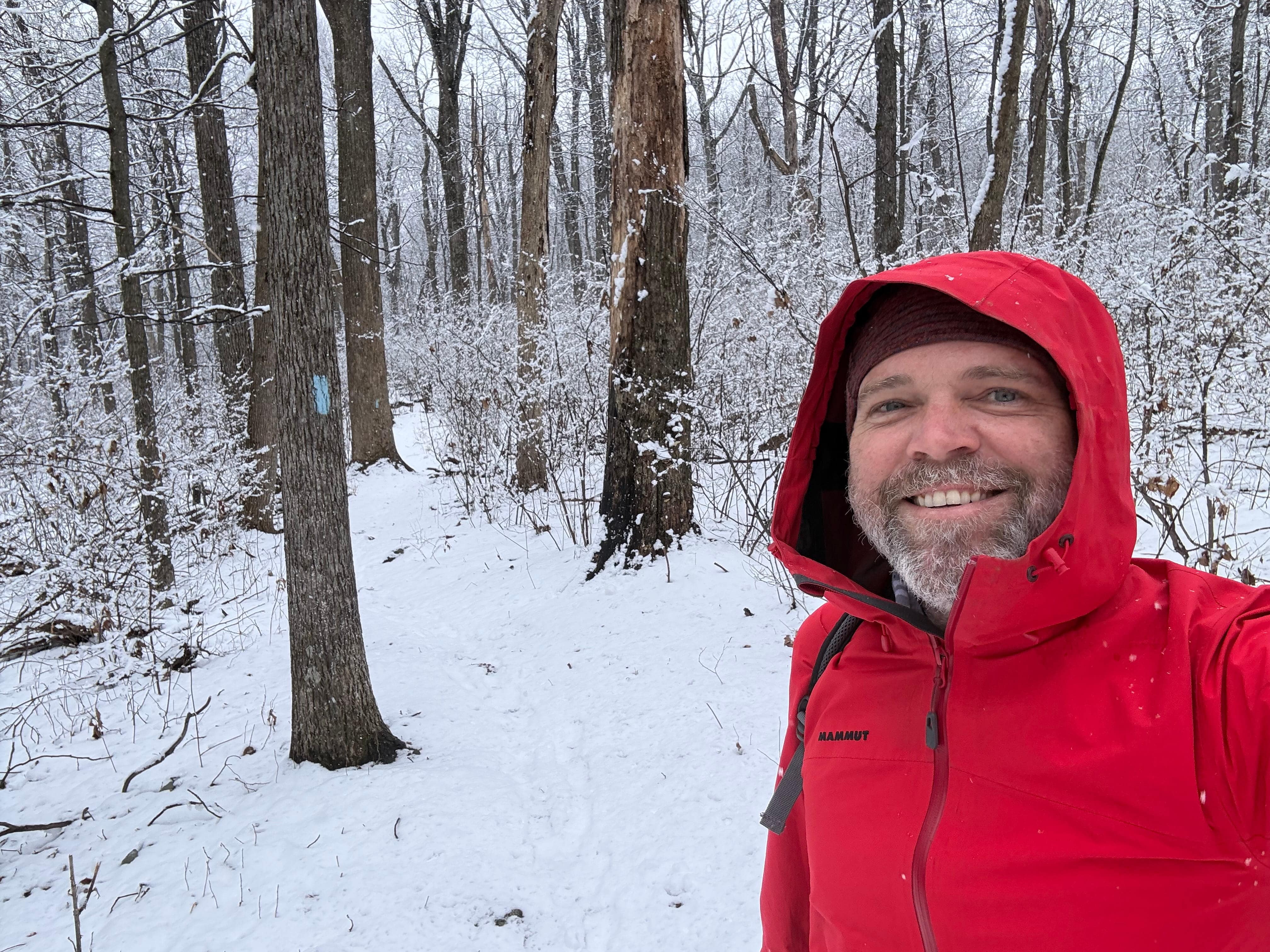
- Never ditch your pack. This one should be obvious, but because I was miserable and am a trail runner, the thought crossed my mind after hiking in freezing rain for roughly 30 hours straight that I just wanted my hike to be over. I was tempted to drop mine, run the last 14.5 miles to the car and come back for my gear. That would have been a complete siren song and an enormous mistake. In conditions like this, you have to keep your tent and sleeping bag with you. Unlike the rest of the year, one twisted ankle or other minor injury could become life-threatening.
- Don’t be afraid to pivot. If you can get a hitch, it may be worth finding a lower elevation alternative or even day hiking, which is what I did on Sunday and Monday. I headed north to Front Royal and lower elevations between 500-1500 feet instead of 2500-3500. It was still snowing and cold but there was a lot less accumulation and the temps and wind chill were probably 5-10 degrees warmer as well.
- Last, always assume the worst. This is especially true for “light hikers.” It doesn’t matter how light and fast you can travel if you’re frozen. As an ultralight hiker in the spring, summer, and fall, I am used to carrying the bare minimum. You just have to bring more back up in case you experience freezing rain for days on end, to the point where everything gets soaked and is beyond the point of drying out on the rest of your hike. I did a good job of keeping my sleeping bag and long underwear dry, and was lucky/happy that the weather took a turn for the better. Otherwise, the last morning of the stretch, I would have had to hike out in my long underwear with a white garbage bag over my torso. Talk about embarrassing. But I deserved it.
My trip wasn’t a total bust. I had a great time over the weekend, running 15 miles in lovely weather through Shenandoah with a good friend. Sitting in his sauna, eating delicious food, and enjoying his family's company was a highlight of the trip. And pivoting to Front Ryoal when the weather looked bad on Sunday so that I was at lower elevations with multiple road crossings and bail out points was a good call.
Monday I was back at it at Rockfish Gap for one final 5.5 mile stretch to Beagle Gap (with an equivalent distance running on Skyline Drive) which was closed. That felt safer because I saw a park ranger in his truck at the midway point and felt like I could bushwhack down to Skyline Drive and make it back to my car at any point if I needed to.
Still, it’s good to remember that it doesn’t matter how close you are to “civilization" if you can’t reach it by yourself and if nobody knows you’re out there (always remember to tell multiple people where you're going, especially when you're hiking solo in the winter).
The consensus among thru-hikers and trail runners is that the Appalachian Mountains are much less dangerous than the Rockies, North Cascades, Sierras, and other ranges out west. But come winter, the Appalachians are no joke and can be just as deadly.
I would highly recommend hiking in the winter. The views are great, the trails and shelters are virtually empty (I hiked 52 miles without seeing anyone else). When the weather is nice, it can be a lot more enjoyable than a hot, muggy, buggy summer day.
BUT… you need to go into the winter hiking with eyes wide open, and that especially goes for ultralight hikers who think they know things. When I go again in winter- and I definitely will) my brain will definitely be recalibrated from “light and fast” to “safe and slow.”

